
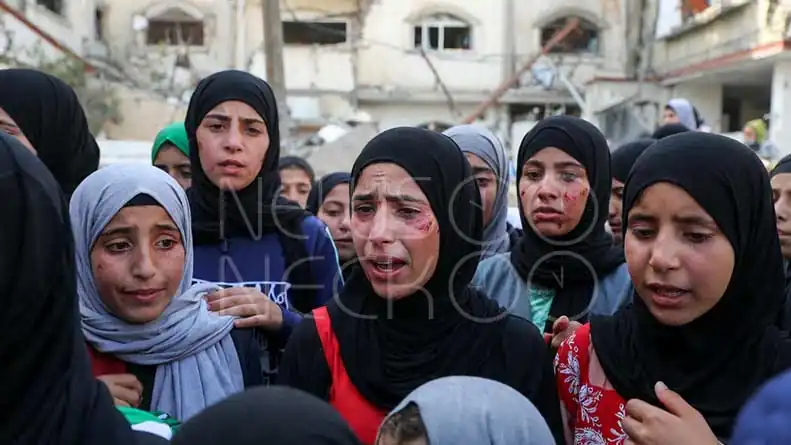
32 Killed in 24 Hours
Deadly violence returned to Gaza on Thursday, 20 November 2025, as Israeli airstrikes once again hit crowded neighborhoods in the southern part of the enclave. According to local health authorities, 32 Palestinians were killed in just 24 hours, making it the highest death toll in weeks. The victims included 12 children and 8 women, marking another devastating chapter in a conflict that shows no sign of ending.
The strikes targeted several areas in Khan Younis, including the towns of Bani Suhaila and Abassan. A house in Bani Suhaila was torn apart by an explosion that killed three people — including a baby girl — and injured at least 15 others. Minutes later, another airstrike in Abassan killed one man and wounded three more. Later in the day, doctors at Nasser Hospital confirmed that a fifth person had been killed by Israeli gunfire, also in Abassan.
Israel’s military confirmed that it had launched the strikes but said it had “no information about casualties.” Meanwhile, both Israel and Hamas continue to accuse each other of violating what is left of a shaky, nearly six-week-old truce.
A Ceasefire in Name Only
For the people of Gaza, the word “ceasefire” has lost its meaning. In many neighborhoods, residents say the attacks never truly stopped.
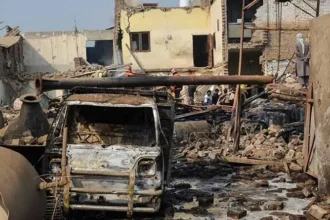
In the Zeitoun suburb of Gaza City, where at least 10 people were killed on Wednesday after a building used to shelter displaced families was struck, survivors were seen digging through rubble to recover whatever belongings remained. Broken furniture, children’s clothes, and shattered memories filled the streets.
“There is no ceasefire,” said Akram Iswair, a resident searching through the debris. “They say it every day, but look around. Missiles still hit us. Poor families are dying. What can we do? Where can our women and children go?”
His words echo a sentiment widely felt across the territory — that the truce offers little real protection.
The ceasefire, which began on October 10 2025 during the second year of the Gaza war, allowed hundreds of thousands of Palestinians to return to what remains of their homes. Israel withdrew troops from central city zones, and humanitarian aid increased. But violence never fully disappeared. Since the truce began, Palestinian officials say 312 people have been killed by Israeli fire.
Israel reports that three of its soldiers have died during the same period and that it has targeted dozens of militants.
You Might Like Reading: US-Brokered Gaza Ceasefire Holds After Major Test
Accusations Over Shifting Boundaries
Tensions grew further when Hamas accused Israel of secretly changing boundary markings that determine which areas Israel still controls under the truce agreement. According to residents in the Shejaia suburb of eastern Gaza City, yellow barricades used to mark Israeli-held zones were moved 100 meters westward, effectively expanding those areas.
Hamas spokesperson Hazem Qassem condemned the move as a violation of the truce maps and a dangerous escalation. He called on Arab mediators, Turkey, and the United States — who brokered the ceasefire — to intervene urgently.
Israel has not yet commented on the accusations.
A War With No End in Sight
The conflict resumed in 2023 after Hamas-led militants attacked southern Israel on October 7, killing 1,200 people and taking 251 hostages. Israel’s response has been devastating: Gaza’s health officials report over 69,000 Palestinians killed, most of them civilians.
Under the terms of the current truce, Hamas released all 20 living hostages it held in Gaza in exchange for nearly 2,000 Palestinian detainees. Hamas also agreed to hand over the remains of 28 dead hostages in return for the bodies of 360 Palestinian militants. So far, Israel has returned 330 bodies.
Yet despite the exchanges, the fighting continues — and the humanitarian suffering grows deeper.
Human Rights Watch: ‘War Crimes in the West Bank’
Adding to the gravity of the situation, Human Rights Watch released a powerful new report on Thursday accusing Israel of committing war crimes and crimes against humanity in the West Bank earlier this year.
The report, titled “All My Dreams Have Been Erased,” details the forced expulsion of 32,000 Palestinians from the refugee camps of Jenin, Tulkarm, and Nur Shams during Operation Iron Wall in January and February 2025. According to the findings, families remain barred from returning, and hundreds of homes were demolished.
“Ten months after their displacement, none of the residents have been allowed to go back,” said Melina Ansari, a researcher involved in the investigation.
Israel responded by saying that infrastructure needed to be demolished to prevent militants from using it but offered no timeline for residents’ return.
A Growing Humanitarian Crisis
With dozens killed in a single day and accusations of war crimes widening, Thursday’s events offer a painful reminder that life for Palestinians remains extremely fragile. The truce meant to provide relief is slowly collapsing, and both sides continue to trade fire and accusations.
For families in Gaza — living in shelters, tents, and shattered buildings — the question is no longer when the war will end, but how much more they will be forced to endure.