
Ancient Giant Awakens
After sleeping through the entire span of human civilization—from the Stone Age to the smartphone era—a volcano in northern Ethiopia has roared back to life, sending a massive ash cloud across international borders and shocking scientists worldwide.
AFAR REGION, Ethiopia – Imagine a force of nature so powerful that it has been silent since woolly mammoths still roamed the Earth. That’s exactly what awakened on Sunday morning in Ethiopia’s remote Afar region when the Hayli Gubbi volcano erupted for the first time in 12,000 years—longer than the entire recorded history of human civilization.
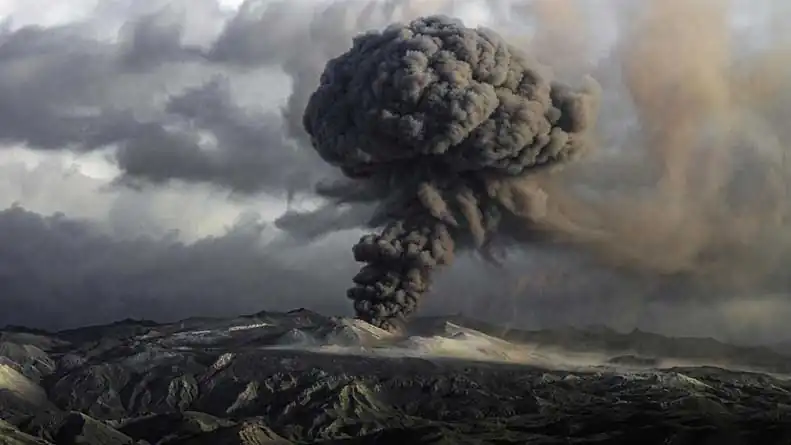
The eruption sent a column of ash and smoke soaring 14 kilometers (nine miles) into the sky—higher than commercial airplanes fly—and transformed what should have been an ordinary Sunday morning into a moment that will be recorded in geological history books.
“Like a Bomb Had Been Thrown”
For the people living near the volcano, the eruption came without warning and with terrifying force.
“It felt like a sudden bomb had been thrown,” said Ahmed Abdela, a resident of the Afar region who experienced the eruption firsthand. That description—comparing the volcanic blast to a bomb—captures the shock and fear that must have gripped the local population as the ancient mountain suddenly came alive.
The Hayli Gubbi volcano, located approximately 800 kilometers (500 miles) northeast of Ethiopia’s capital, Addis Ababa, had been so quiet for so long that most people probably didn’t even think of it as a real threat. It was just another mountain in the landscape. Until Sunday, when it reminded everyone that dormant doesn’t mean dead.
The eruption lasted for several hours on Sunday morning, pumping enormous amounts of volcanic ash into the atmosphere. The nearby village of Afdera, which sits close to the volcano, bore the brunt of the ashfall and was completely covered in a gray blanket of volcanic debris.
Ash Crosses Borders and Seas
The power of the eruption became even more apparent as the ash cloud began its journey across the region. According to the Toulouse Volcanic Ash Advisory Centre (VAAC) in France, which monitors volcanic eruptions worldwide for aviation safety, the thick plumes of smoke didn’t just affect Ethiopia—they traveled across international boundaries.
The ash cloud drifted across the Red Sea, reaching Yemen and Oman on the Arabian Peninsula. But it didn’t stop there. Reports indicated that ash from the eruption eventually reached as far as India and even northern Pakistan—a journey of thousands of kilometers from the eruption site.
This long-distance ash dispersal demonstrates both the power of the eruption and the way volcanic events can have far-reaching consequences beyond their immediate area. Volcanic ash in the atmosphere can affect air quality, disrupt aviation, and even influence weather patterns across vast distances.
Tourists Stranded, But Lives Spared
Despite the dramatic nature of the eruption, there is remarkably good news: no casualties have been reported. In the age of natural disasters that often claim hundreds or thousands of lives, this eruption’s lack of fatalities is a small miracle.
However, the eruption did create immediate problems for people in the area. Many tourists who had been traveling to visit the Danakil Depression—one of the hottest and most inhospitable places on Earth, but also a major tourist attraction known for its otherworldly landscapes—found themselves stranded in ash-covered Afdera on Monday.
These visitors, who came seeking adventure in one of Earth’s most extreme environments, got more than they bargained for when the volcano erupted and left the town buried under layers of volcanic ash.
The Economic Aftermath
Mohammed Seid, a local administrator, confirmed that while human lives were spared, the eruption will have serious economic consequences for the region’s residents.
“While no human lives and livestock have been lost so far, many villages have been covered in ash, and as a result, their animals have little to eat,” Seid explained.
This observation highlights a critical but often overlooked aspect of volcanic eruptions: the long-term economic impact on local communities. The Afar region is home to many livestock herders whose entire livelihoods depend on their animals. When volcanic ash covers grazing lands, it doesn’t just create an immediate problem—it can affect food security and economic stability for months or even years to come.
Livestock need vegetation to eat, and vegetation struggles to grow when buried under layers of ash. Even after the ash settles and the immediate crisis passes, communities may face food shortages, animal deaths, and economic hardship.
A Geological Time Capsule
To understand just how remarkable this eruption is, we need to appreciate the timeline we’re dealing with. The Hayli Gubbi volcano, which rises about 500 meters in altitude, sits within the East African Rift Valley—a massive geological feature where two of Earth’s tectonic plates are slowly pulling apart.
This rift valley is one of the most geologically active zones on the planet, home to numerous volcanoes, hot springs, and earthquake-prone areas. It’s literally where the African continent is being torn in two, a process that will take millions of years to complete.
According to the Smithsonian Institution’s Global Volcanism Program, which maintains comprehensive records of volcanic activity worldwide, Hayli Gubbi has had no known eruptions during what geologists call the Holocene epoch.
The Holocene is the current geological time period, which began approximately 12,000 years ago at the end of the last Ice Age. This means the volcano has been silent through the entirety of what we consider modern human civilization—through the development of agriculture, the rise and fall of ancient empires, the Industrial Revolution, two World Wars, the space age, and the digital era.
What Awakened the Sleeping Giant?
The big question on everyone’s mind is: Why now? What caused a volcano that has been dormant for 12,000 years to suddenly erupt?
While scientists are still investigating, volcanic eruptions in rift valleys like the one in Afar are often linked to the ongoing movement of tectonic plates. As the African continent slowly splits apart, magma from deep within the Earth finds pathways to the surface. Sometimes that magma reaches the surface gradually through geothermal features. Other times, pressure builds until it explodes violently—as happened at Hayli Gubbi.
The East African Rift Valley has numerous active and potentially active volcanoes, and scientists continuously monitor the region for signs of volcanic activity. However, predicting when a long-dormant volcano will erupt remains one of geology’s greatest challenges.
A Reminder of Earth’s Power
This eruption serves as a powerful reminder that we live on a dynamic, ever-changing planet. Mountains that seem permanent and unchanging can suddenly come alive. Forces that have been dormant for millennia can awaken in moments.
For the residents of the Afar region, this eruption has transformed their landscape and their lives. Villages once familiar are now covered in ash. Tourist routes have been disrupted. Livestock herders face uncertain futures as their grazing lands recover.
For scientists, the eruption provides a rare opportunity to study a volcano that hasn’t been active in recorded human history. Every data point collected, every measurement taken, and every observation made will help researchers better understand volcanic systems and potentially improve eruption predictions in the future.
For the rest of us, watching from afar through news reports and satellite images, the eruption is a humbling demonstration of nature’s power and unpredictability.
Looking Forward
As the ash settles—both literally and figuratively—the people of the Afar region face the challenge of recovery and rebuilding. International aid organizations and the Ethiopian government will likely need to provide support to affected communities, particularly those whose livelihoods depend on livestock.
Scientists will continue monitoring Hayli Gubbi closely. After 12,000 years of silence, will this be a single isolated eruption, or has the volcano entered a new period of activity? Only time will tell.
What’s certain is that on a Sunday morning in November 2025, a mountain that had been sleeping since the dawn of civilization decided to wake up—and reminded us all that Earth is far more powerful than anything humanity has ever created.