
Fear to Feminism: How the ‘Pink Protest’ Turned a Town’s Panic Into a National Movement
Last summer, a deep and volatile fear erupted in the peaceful, tree-lined streets of Epping, a commuter town on the outskirts of London where life typically proceeds at the leisurely pace of suburban routine. An Ethiopian man who was staying at the town’s Bell Hotel, which housed asylum seekers, was arrested for the sexual assault of a woman and a 14-year-old schoolgirl. This horrific crime served as the catalyst. Raw and understandable, the community’s pain and rage vanished into the digital ether. Local men were urged to “mask up” and “bring anger” on social media.
On July 17, chaos ensued. Violence broke out during protests. Police officers were attacked with bottles and fists.
Raw and understandable, the community’s pain and rage vanished into the digital ether. Local men were urged to “mask up” and “bring anger” on social media.
For many viewers throughout Britain, the scene was a frightening reminder of the racist riots that had devastated the nation earlier in 2024, when hotels housing asylum seekers were set on fire. Four men would eventually enter guilty pleas to violent disorder in Epping. The scene was set: a town engulfed in rage, its streets a battlefield.
However, Orla Minihane, a mother of three who lives in Epping, felt depressed as she observed the fallout. The violence was a “PR disaster,” in her opinion. It portrayed her community and neighbors as nothing more than “racist thugs.” She felt that the smoke and broken glass obscured the fundamental reason for their protest, which was a deep, protective fear for the safety of women and children. She therefore made the decision to alter the script.
Minihane came up with a fresh idea in the quiet, instant-message bustle of WhatsApp. “The men should stay at home for the next protest,” she said. Women ought to take the “front and center” position. They ought to all dress in pink.
As it happened, the uniform was a brilliant idea.
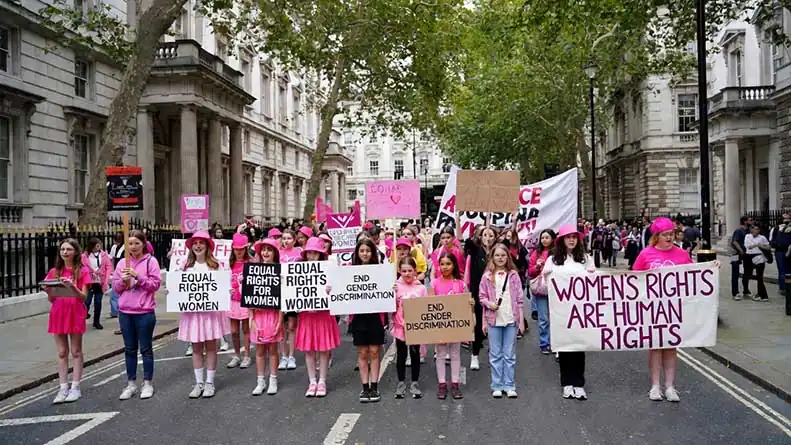
Minihane later told reporters, “It went everywhere – all over the news.” The story changed almost instantly. In the public eye, the angry, masked men were replaced by a row of women wearing pink tops who stood motionless while holding signs that conveyed vulnerability and danger. The “Pink Ladies” emerged from the ashes of a riot.
What started out as a local rebranding initiative quickly expanded into a grassroots movement with a straightforward, potent, and highly contentious message: that women and girls in Britain are directly and existentially threatened by the influx of undocumented migrants, especially men from diverse cultures.
They deliberately distance themselves from the skinhead imagery of far-right groups by staging protests across the nation while wearing pink clothing as a symbol of feminine concern.
The movement follows a cautious path. It has no official affiliation with any political party. Its wording emphasizes protection rather than overt discrimination. However, beneath its pink exterior, there is a strong and obvious political current. Nearly all of the Pink Ladies, according to Minihane, intend to vote for Reform UK, the populist party whose rising popularity has been based on its pledge to “stop the boats,” carry out mass deportations, and take a tough stance against illegal immigration. A startling change in the political landscape of Britain has occurred as Reform UK has been ahead of the ruling Labour Party in a number of opinion polls for months.
In their own way, the Pink Ladies have come to represent the anxieties that give rise to these feelings.
Their rise reveals more about Britain—and many other countries—at a turning point. It tells the tale of how fear that is justified—fear stemming from a horrible crime—can be molded and directed. It demonstrates how a community’s call for safety can become a national talking point through deft symbolism. The Pink Ladies have skillfully reduced a complicated national issue involving international law, border security, and migration policy to a personal, neighborhood-level query: Who is watching out for our daughters?
Opponents contend that despite the movement’s peaceful appearance, it unfairly stigmatizes all asylum seekers as possible predators while ignoring the great majority who are actually escaping persecution and violence. They perceive it as a gentler cover for a harsh anti-immigrant sentiment. On the other hand, supporters feel heard at last. Instead of viewing the Pink Ladies as agitators, they see them as wives and mothers forcing a dialogue that polite society has been too quick to ignore.
The journey from a violent night in Epping to coordinated pink protests across the country is more than a news cycle. It is a case study in how public sentiment morphs and mobilizes. It reveals the power of image over incident, and how the politics of protection can resonate in a worried age. The Bell Hotel in Epping is now quiet, but the movement it indirectly sparked is just finding its voice, one pink shirt at a time, speaking of fear and demanding action in the most visually arresting of ways.
For More visit: NewsNeck