

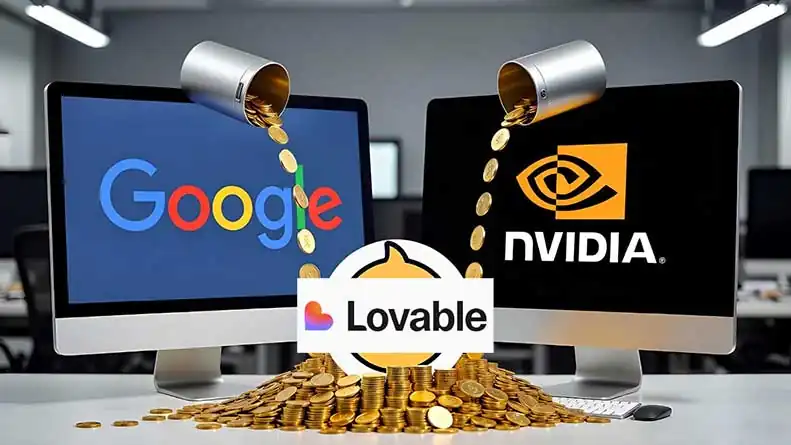
Google and Nvidia Back AI Coding Company Lovable in $6.6 Billion Deal
Lovable is a company that lets people make software without writing code. You just type in English what kind of app or website you want, and the system creates the code for you.
Google and Nvidia have invested new money in this company. Now the company is valued at about $6.6 billion. This is one of the biggest investments in AI software tools this year.
The company announced on Tuesday that it raised more funding, but did not say how much. Google Ventures and Nvidia’s NVentures led the investment, and earlier investors like Andreessen Horowitz also joined.
Lovable works differently from normal coding. You write what you want, and the system generates working code in a few moments. They call this “Vibe Coding.” Developers like it because it saves time and effort.
The company’s CEO, Sharif Shameem, said:
We are seeing teams finish their work 70% faster. Our goal is not to replace programmers, but to help them focus on solving problems instead of writing the same code again and again.
The Company has grown fast since launching in early 2023. It now counts more than 200,000 active users, including developers at several Fortune 500 companies.This platform seamlessly and intuitively supports web applications, mobile interfaces, and data dashboards.
Google’s interest makes sense given its strong focus on expanding AI development tools. The company already provides similar capabilities through its Gemini AI assistant, which can generate code snippets and help debug programs. Nvidia, meanwhile, has been investing heavily in companies that use its chips to power AI systems.
The $6.6 billion valuation puts Lovable in rare company. Only a handful of AI startups have reached that level without going public, including Anthropic and OpenAI. Some analysts question whether the numbers add up, especially as investor enthusiasm for generative AI shows signs of cooling.
“These valuations reflect potential, not current revenue,” said Maria Chen, a venture capital analyst at TechInsight Research. “The question is whether these tools actually save companies enough money to justify the price tag.”
Lovable faces stiff competition. Microsoft’s GitHub Copilot already has millions of paid users. Replit, another coding platform, raised money at a $1.1 billion valuation last year. Cursor, a newer entrant, has been gaining traction with professional developers.
The funding comes as debate intensifies over AI’s role in software development. Some programmers worry the technology will eliminate entry-level jobs. Others argue it will simply change what coding looks like, much like spreadsheets changed accounting.
Industry surveys paint a mixed picture. A recent Stack Overflow poll found that 77 percent of developers now use AI tools regularly. But many still don’t trust the generated code enough to use it in production systems without heavy review.
Lovable says it’s focused on making AI coding more reliable. The company recently added features that let users test generated code automatically and catch errors before deployment. It’s also working on tools to help teams collaborate on AI-generated projects.
The startup plans to use the new funding to expand its engineering team and improve the underlying AI models. Shameem hinted at plans to support more programming languages and integrate with popular development platforms.
For Google and Nvidia, the investment hedges their bets in a fast-moving market. Both companies sell the infrastructure that powers AI tools, but they’re also backing the companies building on top of that infrastructure.
The deal signals continued confidence in generative AI despite recent market jitters. Several AI startups have found it difficult to turn early hype into sustainable business models. However, developer-focused tools have demonstrated greater staying power, mainly because they address specific problems that companies are willing to pay to solve.
Whether Lovable can justify its valuation is still uncertain. The company must show that its technology can scale effectively and meet the complex requirements of enterprise software development. For now, it has both the support—and the pressure—that come with a multibillion-dollar valuation.
For More Visit: NewsNeck