
A deadly explosion tore through a mosque in the Syrian city of Homs on Friday, killing at least eight worshippers and injuring 18 others as people gathered for weekly prayers. The attack has once again raised concerns about sectarian violence and security in a country still struggling to stabilize after years of conflict.
The blast occurred inside the Imam Ali ibn Abi Talib Mosque in the Wadi al-Dhahab neighbourhood, an area largely inhabited by members of the Alawite community. Syria’s Health Ministry confirmed the death toll and number of injured, saying many of the wounded were taken to nearby hospitals for emergency treatment.
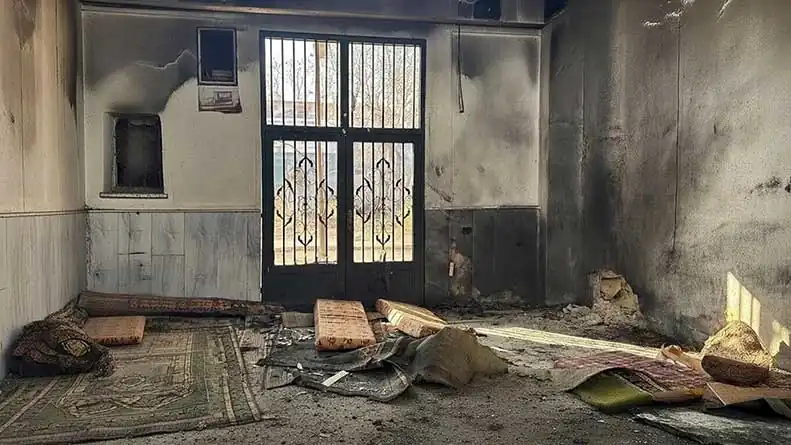
Images released by Syria’s state news agency SANA showed extensive damage inside the mosque. Blackened walls, shattered windows, torn prayer carpets, and visible bloodstains illustrated the force of the explosion and the chaos that followed. Worshippers who survived described moments of panic as smoke filled the prayer hall.
You Might Like Reading: Bangladesh Student Leader Death Sparks Nationwide Violence
Security officials believe an explosive device was detonated from inside the mosque, SANA reported, citing a security source involved in the investigation. Authorities said the area was sealed off shortly after the blast as forensic teams searched for evidence and attempted to determine how the explosive was planted.
Responsibility for the attack has been claimed by Saraya Ansar al-Sunnah, a Sunni extremist group that said it carried out the bombing in coordination with another, unidentified faction. In a statement circulated online, the group said explosives had been placed inside the building in advance.
The Syrian government strongly condemned the attack. In a statement posted on X, Syria’s Foreign Ministry described the bombing as a “terrorist crime” and a “cowardly act” that violates moral and human values. The ministry said the attack was intended to destabilize the country and spread fear among civilians.
The mosque is located in a neighborhood where many residents belong to the Alawite sect, an offshoot of Shia Islam. Alawites make up one of Syria’s largest religious minorities and were closely associated with the former government of Bashar al-Assad, who was himself Alawite.
Some online sources and social media accounts have alleged that the attack was carried out by Israel’s military. However, no independent or official evidence has been presented to support these claims, and Syrian authorities have not linked the blast to the Israeli Defense Forces. Investigators have said the inquiry is ongoing and that conclusions will be based on verified findings.
Saraya Ansar al-Sunnah remains a shadowy group with unclear leadership and structure. It first gained wider attention in June after claiming responsibility for a deadly bombing at a church in Damascus. Its vague origins and limited public presence have led analysts to question whether it operates independently or acts as a cover for more established extremist organizations.
Some regional observers have noted similarities between the group’s messaging and tactics and those previously used by the so-called Islamic State (IS). However, no confirmed link has been established. Syrian authorities have not commented publicly on possible connections between the groups.
The attack follows months of relative silence from Saraya Ansar al-Sunnah, whose previous claims largely involved targeted killings of minorities and individuals it labeled as remnants of the former Assad government. The renewed violence has revived fears of sectarian reprisals.
Syria has remained fragile since rebel forces overthrew Assad about a year ago. Assad later fled to Russia, where he and his family were granted asylum. Since the change in power, tensions between communities have flared at different times, particularly in areas with mixed religious populations.
In March, security forces were accused of killing dozens of Alawite civilians in the coastal province of Latakia, according to the Syrian Observatory for Human Rights (SOHR), a UK-based war monitoring group. The allegations deepened mistrust among minority communities, many of whom fear being targeted amid shifting political realities.
Friday’s bombing has added to those anxieties. Local residents in Homs said the attack struck at a place of worship that had long been considered safe. Community leaders called for restraint and urged authorities to ensure protection for religious sites.
As investigations continue, Syrian officials say their priority is identifying those responsible and preventing further attacks. For many Syrians, however, the blast is another painful reminder that even after years of war, peace remains fragile and deeply uncertain.
For More updates, Visit NEWSNECK