

Summary
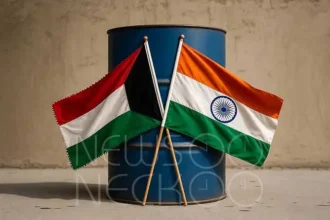
The India Europe Trade Deal marks a historic shift in global trade, creating one of the world’s largest free trade zones covering nearly a quarter of global economic output. Driven by uncertainty in US trade policies and rising protectionism, both India and the European Union are seeking stable, long-term economic partners.
Under the India Europe Trade Deal, tariffs on Indian textiles, leather, gems, and marine exports to Europe will be reduced to zero, while European cars, machinery, and wines will become more affordable in India. The agreement also includes cooperation in defense, clean energy, technology, and supply chain security.
By reducing dependence on the United States and strengthening strategic ties, the India Europe Trade Deal is expected to boost jobs, stabilize markets, and create a more balanced global trade system.
Why India and Europe Are Moving Closer Through Trade Deals
India and Europe are coming closer to each other through trade and strategic deals for several important reasons. One major reason is the trade and tariff policies of U.S. President Donald Trump, which have once again pushed both sides to reduce their dependence on the United States.
In recent days, President Trump’s actions have created uncertainty for Europe. His call for the arrest of Venezuela’s president and his threat to take control of Greenland have raised serious concerns among European leaders. These events have made Europe realize that it can no longer rely too heavily on the United States. As a result, Europe now wants to strengthen its own economy and increase its defense capabilities.
Although the United States is a key member of NATO, Europe itself plays a very important role in the alliance. Any instability in U.S. policies directly affects European security. This is why European countries are now looking for strong economic and strategic partners outside the U.S.
India is facing a similar situation. On several occasions, India has been hit by tariffs imposed by President Trump. These trade restrictions have affected Indian exports and created uncertainty for its economy. Because of this, India is also trying to reduce its reliance on the U.S. market and focus on building a stronger and more independent economy.
This shared challenge has brought India and Europe closer together. Both sides believe that strengthening economic ties with each other should be a top priority. By doing so, they hope to protect their economies from future trade shocks and possible economic disasters.
According to reports by Reuters and CNBC, India and Europe are now seriously analyzing how much they can benefit from a trade deal. These discussions include trade in goods, technology cooperation, defense partnerships, clean energy, and supply chain security.
In the coming years, such trade and strategic agreements could help both India and Europe grow economically, reduce risks, and create a more balanced global trade system that is less dependent on the United States.
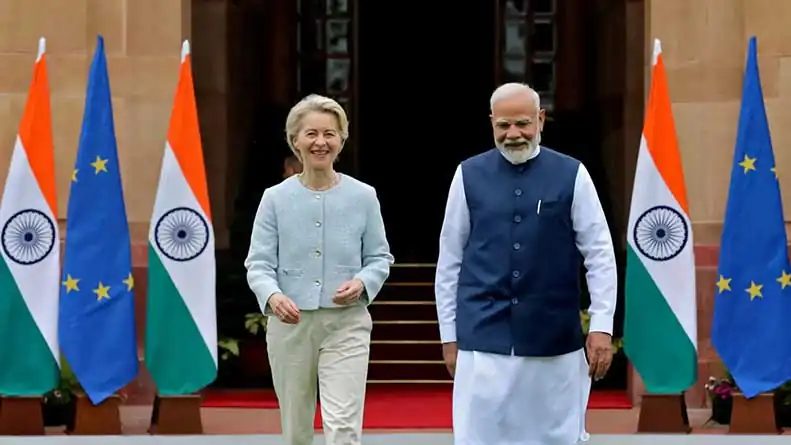
NEW DELHI — In the grand halls of Hyderabad House, a meeting was more than a diplomatic formality. When European Commission President Ursula von der Leyen arrived in an elegant achkan, a traditional Indian coat, and spoke of the auspicious festival of Uttarayan—a time symbolizing a journey from darkness to light—the tone was set. It was a fitting metaphor for a negotiation that had been in the dark for over a decade. On Tuesday, that journey culminated in what leaders are calling the “mother of all deals”: a landmark free trade agreement between the European Union and India.
This isn’t just another trade pact. It binds two billion people—a quarter of humanity—and nearly 25% of the world’s economic output into a new free trade zone. It concludes negotiations that began in 2007, stalled in 2013, and found urgent new life in the past few years. The final push came not from old plans, but from new global realities.
The Engine Behind the Deal: Seeking Shelter from Storms
For years, talks moved slowly. What changed? A world where the old rules of trade are vanishing. Experts point directly to recent unilateral tariffs from the United States and a desire for reliable partners.
“Global trade rules have been thrown up into the air,” explained Professor Biswajit Dhar. “In this scenario, it became important for India and the EU to turn to each other”. This sentiment echoes in diplomatic circles: with the U.S. imposing steep 50% tariffs on some Indian goods and an unpredictable trade policy, both Brussels and New Delhi sought a predictable, stable alternative.
The deal is a strategic pivot. For Europe, it’s access to the world’s fastest-growing large economy and a chance to reduce dependency. For India, it’s a gateway to the EU’s $20 trillion market and a statement that it is open for business on the global stage.
What Changes for People: From Factories to Showrooms
The agreement’s text is complex, but its effects will be felt in everyday life. It is built on a massive, phased elimination of import taxes, known as tariffs.
- For Indian Workers and Exporters: Key industries that employ millions will get a powerful boost. The EU will eventually cut tariffs to zero on Indian marine goods, leather, textiles, gems, and jewellery. This is a game-changer. An Indian garment, which currently faces an 11% duty in Europe, will soon compete on equal footing with duty-free products from Bangladesh and Vietnam. Council for Leather Exports chairman Ramesh Juneja expects exports to the EU to nearly triple, from $2.25 billion to $6 billion by 2030.
- For European Brands and Indian Consumers: European products that were once luxury items due to high taxes will become more accessible. The most dramatic shift is for cars. India will slash tariffs on European automobiles from as high as 110% down to 10% over five years. This means brands like Mercedes-Benz, BMW, and Volkswagen can sell imported vehicles at significantly lower prices. Your glass might also feel the change: tariffs on EU wines will drop immediately from 150% to 75%, eventually falling to around 20%.
A quick look at the major shifts:
| Sector/Product | Current Tariff | New Tariff | Key Impact |
|---|---|---|---|
| European Cars to India | Up to 110% | As low as 10% over 5 yrs | Luxury & premium cars become more affordable. |
| EU Wines to India | 150% | ~20% (phased) | Wider variety, lower prices for consumers. |
| Indian Textiles to EU | Up to 11% | 0% (phased) | Boosts a major job-creating sector; better competition. |
| EU Machinery to India | Up to 44% | Mostly 0% (phased) | Cheaper industrial goods for Indian businesses. |
What Was Protected: The Delicate Balance
No deal this large is possible without compromise and protection. The most sensitive areas—agriculture and dairy—were intentionally kept off the table. The EU protected its markets for beef, sugar, and rice, while India shielded the livelihoods of its small-scale farmers and its dairy sector. This careful balance was essential to getting the deal across the finish line.
More Than Goods: A Partnership for the Future
The agreement goes far beyond tariffs. It includes the most ambitious services commitment India has ever made, granting European companies privileged access to sectors like financial services and maritime transport. A new Security and Defence Partnership was also announced, aiming for co-development and co-production of military technology.
Crucially, it is framed as a partnership of shared values. The deal includes commitments to uphold the Paris Climate Agreement, protect workers’ rights, and support women’s economic empowerment. A €500 million EU fund will help India cut emissions and transform industries sustainably.
The Road Ahead
The political declaration is signed, but the process isn’t over. The legal text must now be “scrubbed,” translated, and formally ratified by the European Parliament and Indian government, a process expected to take about six months. Implementation is likely in early 2027.
When it takes effect, it will be more than a list of tariff codes. As former ambassador Sanjay Bhattacharyya told DW, it creates a “dynamic economic environment.” He predicts, “Today it may benefit textiles, pharmaceuticals or agriculture. Tomorrow it could be semiconductors and critical materials”.
In a world drifting toward protectionism and unpredictable tariffs, the India-EU deal is a bold bet on a different path. It’s a bet that two vast democracies, by weaving their economies closer together, can build a more stable and prosperous foundation for the future. As Ursula von der Leyen said, “This is only the beginning”.
For More Visit NewsNeck

2 Comments
xv0lqq
qmd3wr